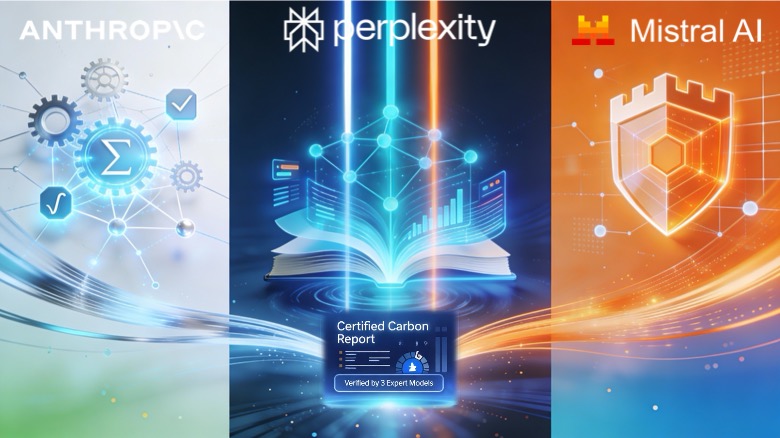
Three AI Engines, Three Jobs
Published January 21, 2026 · Updated July 8, 2026 | By Carbon Intelligence Team | 6 min read
The calculations are ours. The AI only translates.
First, the part that matters most: Carbon Intelligence does not compute your footprint with a language model. Emissions are calculated by our own engine — aligned with GMSF v1.3, ISO 14064, and the GHG Protocol — from real activity data: impressions served, data transferred, supply-path depth, device mix, and regional energy factors.
The AI comes in after the numbers. Its job is to turn a dense, multi-variable result into a clear, defensible recommendation. And for that job, one model rarely fits every situation.
So instead of betting on a single model, we route each analysis to the engine best suited to it — and let you choose.
The hallucination problem, and why routing beats betting
Our answer isn’t to trust one “best” model blindly. It’s to match the model to the job — reasoning, grounding, or sovereignty — and to keep every figure traceable back to the engine that produced it, not the language model that phrased it.
Claude — deep strategic reasoning
Best for: multi-variable analysis, fine decomposition, optimization strategy.
When a campaign spans geographies, formats, and device mixes, Claude untangles the interactions and explains the why: “shifting 40% of budget from HD video to static display cuts emissions 12%, for a 3% CTR impact.” In Carbon Intelligence this powers the deep brief — the most thorough analysis we offer, for when the stakes justify the extra minutes.
Gemini — grounded, sourced market intelligence
Best for: fresh context, competitive benchmarks, evolving standards.
Carbon standards move constantly (IEA factors, EPA eGRID, GHG Protocol updates). Gemini runs with live web grounding: it pulls the most recent, sourced information and cites it — so a benchmark (“retail advertisers average 0.8 gCO₂/impression; you’re at 1.2”) arrives with a link you can verify. This is our standard engine, and the default for most analyses.
Sovereign EU open models — data that never leaves Europe
Best for: data-residency constraints, strict GDPR, public-sector clients.
Some organizations cannot send campaign data outside the EU. For them, Carbon Intelligence runs open models hosted on OVHcloud’s sovereign infrastructure in France: the analysis happens in-region, and no data leaves the European Union. This is the sovereign mode — selectable per brief, or enforced across an entire organization.
Which engine for which need?
| Criteria | 🟠 Claude | 🔵 Gemini | 🇪🇺 Sovereign EU |
|---|---|---|---|
| Main strength | Deep strategic reasoning | Fresh, sourced web context | EU data residency |
| Best for | Complex optimization | Benchmarks & market context | GDPR-sensitive clients |
| In the product | Deep brief mode | Standard (default) | Sovereign mode |
| Ideal if… | You need the "why" | You need "compared to what" | You need "compliant where" |
Déméter — the copilot that puts it together
The old promise was “one day, orchestration.” That day arrived. Déméter, our carbon copilot, is where these engines meet your data: it reads your advertiser context, benchmarks you against comparable campaigns, grounds itself on the sourced web — and turns the result into a strategic brief you can export to PDF and PowerPoint, board- and CSRD-ready.
You pick the engine; Déméter does the work.
Robustness through diversity
Independent models fail in independent ways. Claude can slip on very recent facts; a grounded search can over-weight a single source; a conservative open model can under-recommend. Routing each question to the right engine — and, increasingly, cross-checking across them — turns that diversity into confidence: when engines converge, trust rises; when they diverge, it’s a signal to look closer.
Roadmap
Today
- Choose your engine per analysis: Claude, Gemini, or sovereign EU
- Déméter orchestrates advertiser context, peer benchmarks & sourced web
Next
- Auto-recommended engine, suggested per query
Beyond
- Multi-engine consensus on the most critical analyses
Try it on your own campaigns
See it on your own data
Log in and, on your next analysis, pick your engine — Claude, Gemini, or sovereign EU — and let Déméter turn the numbers into a board-ready brief.
Bottom line
Generative AI isn’t a magic answer; it’s a tool whose value depends on the job at hand. Carbon Intelligence keeps the math in its own engine, routes the explanation to the right model — Claude for reasoning, Gemini for sourced context, sovereign EU models for data residency — and lets Déméter tie it together, so every recommendation is clear, sourced, and traceable.
Follow our progress: LinkedIn | Blog
Tags: #CarbonIntelligence #Claude #Gemini #Sovereignty #Déméter #Sustainability #CSRD #DigitalAdvertising