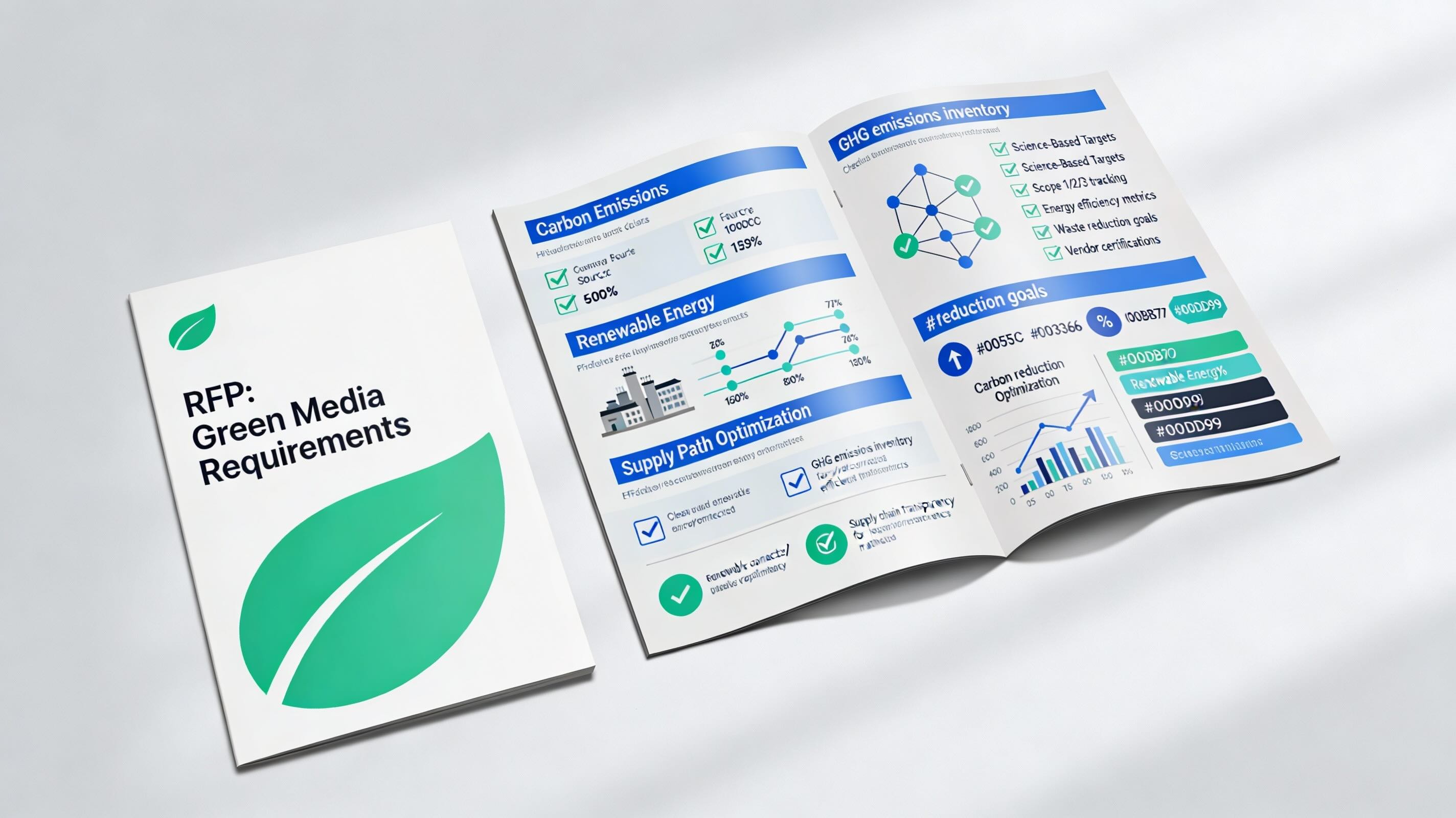
The RFP just landed. Scroll past the standard reach and frequency requirements, audience targeting specs, brand safety protocols. There, buried in section 7.3: “Vendor must provide emissions profiles for all proposed media buys and demonstrate capability to reduce campaign carbon footprint by minimum 25% without performance degradation.”
Welcome to green media procurement in 2026.
RFPs Now Include Carbon Reduction Requirements
Sustainability clauses in advertising RFPs were rare in 2023, experimental in 2024, common in 2025. By 2026, they’re standard.
A survey of 240 advertiser RFPs issued in Q4 2025 found:
- 67% included specific carbon measurement requirements
- 43% set explicit emissions reduction targets
- 38% required GMSF-compliant reporting
- 29% weighted sustainability in vendor scoring (typically 10-15% of total score)
- 18% made carbon capability a mandatory qualification (failure to demonstrate = disqualification)
These aren’t fringe advertisers. They’re mainstream consumer brands, financial services companies, automotive manufacturers, technology firms. Industries across the board are embedding sustainability into advertising procurement.
The shift happened fast. In 2023, sustainability in RFPs was usually vague language about “corporate responsibility” or “consideration of environmental impact.” In 2026, it’s specific, measurable, and consequential.
The Trend: “Sustainable Media” Line Items Becoming Standard
RFPs are evolving from awareness to action. The progression looks like this:
2023: Awareness “We value sustainability and encourage vendors to consider environmental impact in their proposals.” Translation: We know this matters but don’t know what to ask for.
2024: Measurement “Please provide estimated carbon emissions for proposed campaigns using recognized calculation methodology.” Translation: We want data but we’re not sure what to do with it.
2025: Targets “Vendor must demonstrate ability to measure campaign emissions and provide optimization recommendations to reduce carbon intensity.” Translation: We expect you to have solutions, not just measurements.
2026: Requirements “All media plans must include emissions profile, supply path optimization strategy, and documented approach to achieving 25% reduction vs. baseline. Carbon performance will be tracked quarterly and included in vendor performance reviews.” Translation: This is now part of how we evaluate your work.
The language changed from aspirational to operational. Sustainability isn’t a separate sustainability section—it’s integrated into media planning requirements, reporting specifications, and performance evaluation criteria.
What Clients Are Asking For
The specific requirements vary by advertiser sophistication and industry, but common asks include:
Baseline emissions measurement: Calculate carbon footprint of existing campaigns or proposed media plans. Must use activity-based methodology (GMSF v1.3 or equivalent), not spend-based estimates. Clients want to see emissions per impression, per channel, per campaign element.
Supply path emission profiles: Identify which supply paths, publishers, and ad tech intermediaries generate highest emissions. Map the entire programmatic supply chain showing data transfers, bidding activities, and infrastructure hops. Clients want transparency into where emissions come from.
Optimization recommendations: Don’t just report emissions—propose specific actions to reduce them. This might include supply path optimization, creative file compression, preference for direct publisher relationships, carbon-aware bidding strategies, or shifts in channel mix.
Performance maintenance guarantees: The critical requirement: prove carbon reduction doesn’t sacrifice campaign effectiveness. Clients want data showing that lower-emission approaches maintain or improve reach, engagement, and conversion metrics.
Ongoing tracking and reporting: Sustainability isn’t a one-time deliverable. RFPs increasingly require quarterly carbon reports integrated into standard campaign dashboards. Emissions become a standing KPI alongside impressions, CTR, and conversions.
Verification and audit trails: For advertisers facing regulatory disclosure requirements (CSRD, California Scope 3), carbon data must be auditable. RFPs ask for documentation showing calculation methodology, data sources, and quality assurance processes that will satisfy third-party verifiers.
Real Examples: Brands Requiring Carbon Data in 2026
Specific examples illustrate how requirements manifest:
Global CPG company (annual media spend: €180M): 2026 agency RFP included 15% sustainability weighting in vendor scoring. Requirements: GMSF v1.3 measurement for all campaigns, quarterly emissions reports by channel, documented reduction roadmap targeting 30% lower emissions per impression by 2028. Agencies without carbon measurement capability were eliminated in initial screening.
European automotive manufacturer (annual media spend: €95M): RFP mandated carbon-aware programmatic buying for all digital campaigns. Required proof of DSP integration with GMSF data, demonstration of carbon-weighted bidding algorithms, and commitment to monthly reporting showing emissions trends. Winning agency needed to show they’d already implemented carbon-aware buying for other clients.
US financial services firm (annual media spend: $120M): RFP required all vendors to participate in quarterly “sustainability reviews” alongside performance reviews. Agenda includes emissions data by campaign, progress toward reduction targets, and sharing of best practices. Carbon performance affects vendor contract renewal decisions.
UK retail chain (annual media spend: £65M): Added sustainability addendum to existing contracts mid-2025, requiring retroactive emissions calculation for 2024 campaigns and forward-looking measurement for all 2026 activity. Suppliers had 90 days to implement compliant measurement or face contract termination.
Asian technology company (annual media spend: $200M): Issued RFP requiring vendors to demonstrate “net-zero advertising pathway”—a credible plan for reaching zero net emissions from advertising operations by 2035. Required detailed analysis of current emissions, reduction levers, realistic timelines, and offset strategies for residual emissions.
The common thread: these aren’t exploratory or optional. They’re binding contractual requirements with business consequences for non-compliance.
What Agencies/SSPs/Publishers Must Prove
The burden falls on the supply side to demonstrate carbon capability. Vendors face multiple proving grounds:
For agencies:
- Technical capability: Do you have carbon measurement infrastructure? Can you collect activity data from ad tech platforms? Can you calculate emissions using GMSF methodology?
- Experience: Have you done this before? Can you show case studies of carbon-optimized campaigns with maintained performance?
- Resources: Do you have dedicated sustainability expertise? Who owns this within your organization?
- Integration: Is carbon data integrated into standard campaign planning and reporting, or is it a separate bolt-on?
For SSPs and ad tech platforms:
- Data availability: Can you provide impression-level emissions data to buyers? Is it accessible via API or UI?
- GMSF compliance: Are your emissions calculations based on GMSF v1.3 standardized factors?
- Transparency: Can you show emissions by supply path, publisher, creative type? Can buyers understand where emissions come from?
- Optimization tools: Do you offer carbon-aware bidding, carbon filtering, or emissions-based reporting within your platform?
For publishers:
- Emissions disclosure: What’s the carbon footprint of serving ads on your properties? Can you provide this data to buyers?
- Infrastructure efficiency: What’s your data center energy source? Are you using renewable energy? How optimized is your content delivery?
- Competitive positioning: Can you demonstrate lower emissions than competitor publishers? Is this a differentiator in sales conversations?
The vendors succeeding in RFPs aren’t necessarily the ones with the lowest emissions. They’re the ones who can measure accurately, report transparently, and demonstrate continuous improvement.
Supply Path Curation Based on Emissions
One of the most concrete applications of carbon data: supply path optimization now incorporates emissions alongside cost and quality metrics.
Supply path optimization (SPO) traditionally focused on:
- Reducing ad tech fees (shorter supply chains = lower cost)
- Improving inventory quality (direct paths = less fraud, better viewability)
- Increasing speed (fewer hops = faster load times)
In 2026, add a fourth dimension:
- Lowering emissions (efficient paths = less data transfer, computation, and energy)
The mechanics are straightforward. A programmatic impression might reach a buyer through multiple supply paths:
Path A: Direct SSP connection Advertiser DSP → SSP → Publisher ad server → User device Emissions: 0.8g CO2e per 1,000 impressions
Path B: Multi-hop intermediated path Advertiser DSP → Bidding intermediary → SSP → Ad exchange → Publisher ad server → User device Emissions: 2.1g CO2e per 1,000 impressions
Path B has 163% higher emissions due to additional data transfers, bidding computations, and server processing. It probably also has higher fees, lower viewability, and slower delivery.
Supply path curation based on emissions means systematically preferring Path A. This isn’t a new concept—it’s existing SPO practices enhanced with carbon data.
The impact shows up in RFP responses. Agencies are now including supply path emission profiles in media plans: “We’ve curated supply paths to reduce intermediaries from industry average of 4.2 hops to 2.1 hops, reducing emissions 43% while improving viewability 18% and lowering CPMs 22%.”
Three optimizations in one. That’s a compelling RFP answer.
Testing the “No Performance Penalty” Claim
The skepticism clients raise: “Carbon optimization sounds great, but will it hurt performance?”
Fair question. The advertising industry has decades of experience with constraints that seem reasonable until they degrade results. Brand safety filters that eliminate too much inventory. Viewability requirements that shrink audience reach. Fraud prevention that blocks legitimate traffic.
Could carbon optimization be another well-intentioned constraint that compromises campaign effectiveness?
The data from 2026 implementations suggests not—but with nuance.
Analysis of 312 campaigns with carbon optimization (Q1 2026):
Campaigns with light carbon optimization (preference for lower-emission inventory, no hard constraints):
- 31% reduction in emissions per 1,000 impressions
- 4% improvement in CTR (median)
- 7% reduction in CPA (median)
- 98% reached target audience size within 5%
Campaigns with moderate carbon optimization (carbon-weighted bidding, supply path curation):
- 48% reduction in emissions per 1,000 impressions
- 6% improvement in CTR (median)
- 11% reduction in CPA (median)
- 94% reached target audience size within 5%
Campaigns with aggressive carbon optimization (strict emissions caps, heavy carbon bidding penalties):
- 67% reduction in emissions per 1,000 impressions
- 2% improvement in CTR (median)
- 3% reduction in CPA (median)
- 79% reached target audience size within 5%
The pattern: moderate carbon optimization improves both emissions and performance. Aggressive optimization still reduces emissions dramatically but starts to constrain inventory availability, particularly in niche audience segments.
Why does moderate carbon optimization often improve performance? Because emissions correlate with inefficiency. Heavy supply chains, bloated creative files, distant servers, and low-quality inventory all generate more emissions and worse results. Optimizing for carbon often means optimizing for quality.
RFP responses now include this data prominently: “Carbon optimization doesn’t trade off against performance—it often enhances it by steering toward efficient, high-quality inventory.”
Competitive Advantage for Vendors Who Can Provide Carbon Data
The vendors who built carbon capability early are winning RFPs.
A European agency network reported that in Q4 2025, they won 73% of RFPs where sustainability was weighted in vendor evaluation, compared to their historical 42% win rate. The difference: they’d invested in GMSF measurement infrastructure in early 2025, giving them 9-12 months of case studies and proven capability while competitors scrambled.
An SSP that implemented GMSF-compliant emissions data in their buyer reporting saw 22% growth in spending from sustainability-focused advertisers in 2025, compared to 8% growth in their overall business.
A publisher with detailed emissions disclosure and renewable energy infrastructure used sustainability as a sales differentiator, winning direct deals with automotive and technology advertisers who paid 15-20% CPM premiums for “verified low-carbon inventory.”
The competitive dynamic is shifting. In 2024, carbon capability was a differentiator—something to highlight in sales pitches. In 2026, it’s becoming table stakes—something required just to stay in the conversation.
RFPs increasingly include carbon capability in qualification criteria, not evaluation criteria. The difference: qualification criteria are pass/fail requirements (lack of capability = automatic elimination), while evaluation criteria are scored comparatively (better capability = higher score).
When carbon moves from evaluation to qualification, vendors without measurement capability don’t even get to compete on other dimensions. They’re out before the real evaluation begins.
How to Respond to Green Media RFPs
Practical guidance for vendors facing sustainability requirements in 2026 RFPs:
If you have carbon measurement capability:
Lead with it. Put carbon data in the executive summary, not buried in appendices. Show you’ve been doing this, not that you’re learning.
Provide specific data. Don’t say “we can measure emissions.” Say “we measured 847 campaigns in 2025 totaling 18.2 billion impressions, with average emissions of 0.52g CO2e per 1,000 impressions, down 34% from our 2024 baseline.”
Show case studies. Include 2-3 examples of carbon-optimized campaigns with full performance data. Demonstrate that emissions reduction maintained or improved effectiveness.
Explain methodology. Clients want to know your calculations will stand up to audit. Document your use of GMSF v1.3, data sources, quality assurance processes.
Propose specific actions. Don’t just offer to measure—propose a carbon reduction strategy tailored to the client’s media mix and goals.
Integrate into standard reporting. Show mockups of how carbon data appears in campaign dashboards alongside traditional metrics. Make it normal, not special.
If you don’t have carbon measurement capability:
Don’t ignore it. Addressing the requirement poorly is better than skipping it entirely. Explain your current limitations and implementation roadmap.
Commit to a timeline. “We will implement GMSF-compliant measurement by Q2 2026 through partnership with [vendor name].” Give clients confidence you’ll have capability soon.
Partner if needed. Several measurement vendors offer white-label solutions. You can provide carbon data through partnerships while building internal capability.
Don’t promise what you can’t deliver. Clients will hold you accountable. Better to commit to a realistic timeline than overpromise and underdeliver.
Acknowledge the gap. “Sustainability measurement is an area where we’re building capability. We recognize this is important to you and have committed resources to close this gap within [timeframe].”
The worst response: silence. Ignoring sustainability requirements in RFPs signals either that you don’t take client priorities seriously or that you lack capability and hope they won’t notice.
Future: This Becomes Table Stakes, Not Differentiator
The trajectory is clear. Carbon capability is following the same path as viewability, brand safety, and fraud prevention—specialized capabilities that become industry standards.
The adoption curve:
- 2022-2023: Early adopters experiment with carbon measurement
- 2024: Awareness spreads, vendors begin building capability
- 2025: Leaders establish competitive advantage through carbon data
- 2026: Mainstream adoption, RFPs routinely include requirements
- 2027-2028: Standard expectation, lack of capability disqualifies vendors
- 2029+: Commodity capability, differentiation moves to advanced optimization and reduction results
We’re currently in the 2026 phase: mainstream adoption. Carbon capability still provides competitive advantage, but the window is closing. By 2027-2028, not having carbon measurement will be like not having viewability measurement in 2020—it simply disqualifies you from serious consideration.
The vendors positioning for the next phase aren’t just implementing measurement. They’re developing:
- Advanced carbon optimization algorithms
- Supply chain partnerships to reduce emissions
- Renewable energy procurement for ad tech infrastructure
- Carbon removal strategies for residual emissions
- Integration with client sustainability platforms and reporting systems
These advanced capabilities will be the differentiators when basic measurement becomes standard.
The Procurement Power of Sustainability
Why is this happening so fast? Because procurement departments have power.
CMOs might care about sustainability for brand and values reasons. CFOs might care for regulatory compliance reasons. But procurement teams care because it’s a concrete, measurable vendor evaluation criterion that’s harder to game than subjective assessments.
Procurement loves sustainability requirements because:
- They’re objective (emissions are quantifiable)
- They’re verifiable (third-party audits possible)
- They drive efficiency (carbon optimization often reduces costs)
- They satisfy multiple stakeholders (sustainability teams, executives, boards)
- They’re defensible (hard to argue against environmental responsibility)
Once procurement embraces sustainability as an evaluation criterion, it becomes institutionalized in RFP templates, vendor scorecards, and contract terms. It doesn’t require ongoing executive attention—it’s embedded in the procurement process.
That’s why carbon requirements spread so quickly. A few large advertisers added sustainability clauses to RFPs in 2024. Procurement teams at other companies saw this, liked the framework, and adopted similar language. Industry associations developed standardized sustainability RFP language. Consultants recommended best practices. Within two years, it became normal.
The Business Reality
For vendors, the calculus is straightforward: invest in carbon measurement capability or lose access to a growing segment of RFPs.
The implementation cost is material but manageable:
- GMSF-compliant measurement platform: $20,000-100,000 annually (depending on scale)
- Internal resources for implementation: 500-1,000 hours
- Ongoing carbon reporting and analysis: 0.5-1.0 FTE
- Training and change management: $10,000-30,000
Total first-year cost for mid-sized agency: $100,000-200,000.
Compare that to the value of RFPs now requiring carbon capability. If 30% of RFPs include sustainability requirements (conservative estimate for 2026), and you’re automatically disqualified from those RFPs without carbon capability, you’ve just lost access to 30% of new business opportunities.
For an agency pitching $50M in annual new business, 30% is $15M. Investing $150,000 to compete for $15M is an obvious decision.
That’s why adoption is accelerating. The business case is clear, the implementation is proven, and the competitive pressure is mounting.
Getting Ready for Sustainable Media RFPs
If you’re a vendor who hasn’t implemented carbon measurement, here’s your roadmap:
Month 1: Assess and decide
- Inventory current capability (can you collect activity data from ad tech platforms?)
- Review recent RFPs to see sustainability requirements you’ve encountered
- Calculate opportunity cost of not having carbon capability
- Decide: build internal capability or partner with measurement vendor
- Allocate budget and resources
Month 2: Implement measurement
- Select and implement GMSF-compliant measurement platform
- Integrate with existing ad tech systems (DSPs, ad servers, analytics)
- Begin collecting carbon data for current campaigns
- Establish baseline emissions profiles
Month 3: Test and refine
- Run carbon measurement on 5-10 campaigns
- Validate data quality and completeness
- Develop initial carbon optimization strategies
- Create internal reporting templates
Month 4: Scale and document
- Expand carbon measurement to all campaigns
- Document methodology and processes for RFP responses
- Train client-facing teams on carbon data and sustainability positioning
- Develop case studies from early implementations
Month 5: Optimize and differentiate
- Begin testing carbon optimization strategies
- Measure performance impact
- Refine approaches based on results
- Develop advanced capability roadmap
Month 6: Market and win
- Update RFP response templates with carbon capability
- Proactively present carbon data to existing clients
- Use sustainability as sales differentiator in new business pitches
- Track win rates on RFPs with sustainability requirements
Six months from decision to competitive advantage. The vendors who started this process in late 2025 are winning RFPs in 2026. The vendors starting now will be competitive by mid-2026.
The vendors waiting to see if this trend continues will find themselves disqualified from a growing percentage of opportunities.
The Bottom Line
Green media buying is no longer emerging—it’s here. RFPs routinely include carbon requirements, clients expect emissions data, and vendors without measurement capability are losing competitive access.
This isn’t a trend that might materialize in the future. It’s a present reality reshaping procurement processes across the advertising industry.
The vendors who will thrive are those who:
- Implement carbon measurement immediately
- Integrate sustainability into standard operations, not separate initiatives
- Develop optimization strategies that reduce emissions while maintaining performance
- Position carbon capability prominently in RFP responses and sales conversations
- Continue investing in advanced sustainability capabilities as basic measurement becomes standard
The window for competitive advantage is open but closing. Act now, or explain later why you’re not qualified for an increasing share of opportunities.
Need carbon measurement capability to respond to RFPs? Carbon Intelligence provides GMSF-compliant measurement platforms for agencies, SSPs, and publishers. We help vendors implement carbon tracking, respond to sustainability RFPs, and develop optimization strategies. Contact us to discuss your carbon capability roadmap.
About Carbon Intelligence: We provide carbon measurement, optimization, and compliance solutions for digital advertising. Our platform helps agencies, ad tech vendors, and publishers respond to client sustainability requirements with accurate, verifiable emissions data.