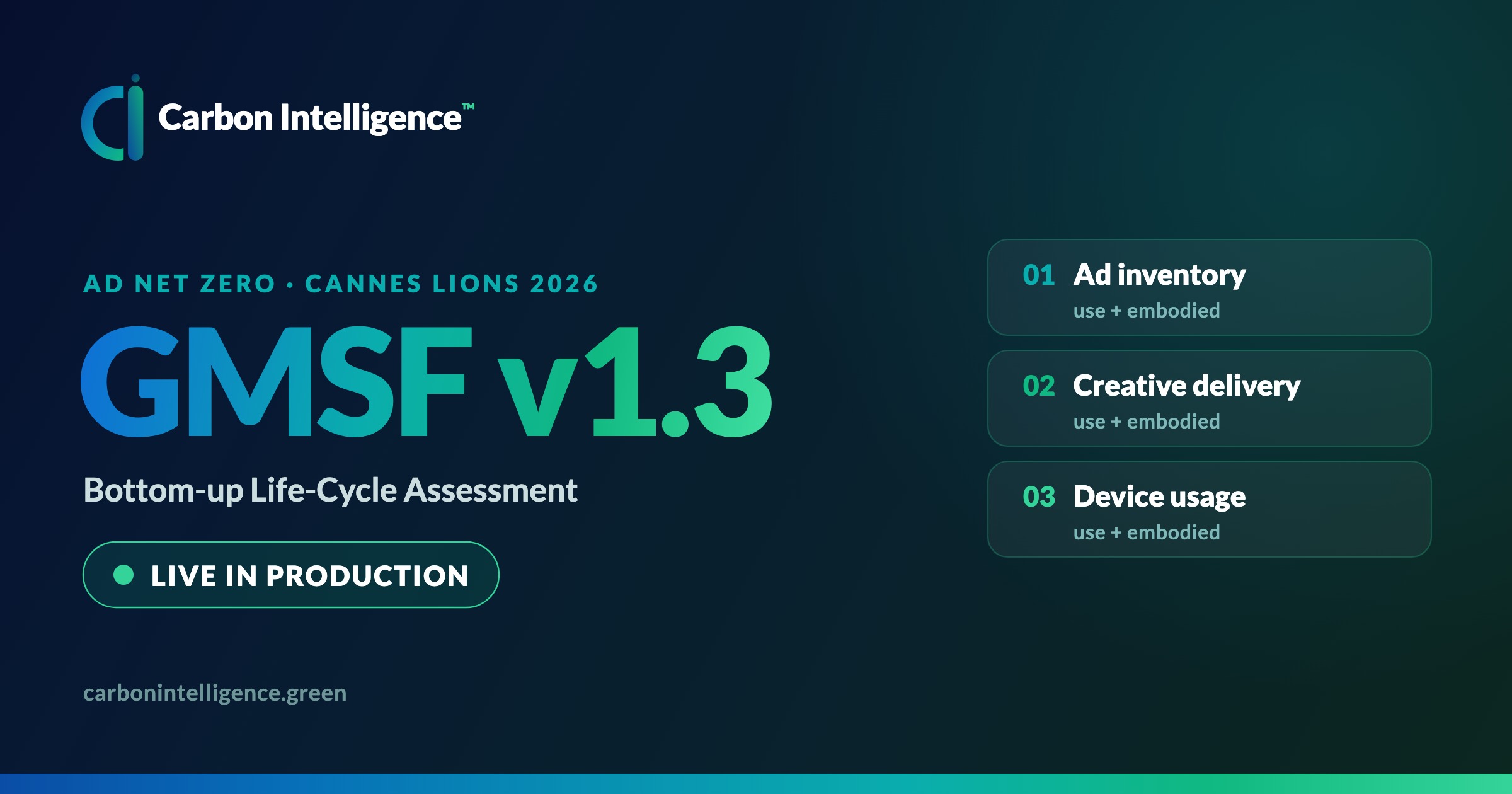
Carbon Intelligence Adopts GMSF v1.3: What Really Changes in Advertising Carbon Measurement
Last week, at Cannes Lions 2026, Ad Net Zero unveiled version 1.3 of the Global Media Sustainability Framework (GMSF), the new global standard for measuring the carbon footprint of digital advertising. At Carbon Intelligence, we didn’t wait: GMSF v1.3 is already live on our platform, making us one of the very first players to implement it end to end.
But beyond the announcement, v1.3 represents a genuine shift in methodological paradigm. Here, in concrete terms, is what changes between v1.2 and v1.3, and why it matters for any advertiser that takes carbon measurement seriously.
GMSF, the common language of media carbon measurement
Driven by the industry under the leadership of Ad Net Zero, the GMSF standardizes how a media campaign’s emissions are calculated: the same boundaries, the same factors, the same rules for allocating impact across players. It is this shared framework that makes it possible to compare two campaigns on an honest basis and to produce reports that hold up in front of a CSRD auditor.
Version 1.2 established activity-based measurement, a welcome break from spend-based approaches. Version 1.3 goes much further.
v1.2: activity-based measurement
v1.2 marked a decisive step by replacing spend-based estimates, which infer carbon from budget, with measurement anchored in real activities: impressions served, data transferred, seconds of video encoded, multiplied by standardized emission factors. Accurate, reproducible, auditable. We explained why this approach is superior to spend-based in our comparison of GMSF vs the spend-based method.
But v1.2 still had two major blind spots:
- it focused on the use phase, that is, the electricity consumed during delivery;
- it did not account for hardware manufacturing (servers, devices, networks), nor for the true depth of the chain of programmatic intermediaries.
v1.3: life cycle assessment, built from the bottom up
v1.3 moves measurement from an activity-based logic to a true life cycle assessment (LCA), modeled from the bottom up. Three fundamental differences.
1. Embodied carbon enters the calculation
This is the big new development. Beyond the energy consumed during delivery, v1.3 counts the manufacturing carbon of the equipment involved: data centers, network antennas, and above all end-user devices. This component, ignored until now, is often the largest of them all. Measuring the electricity a smartphone draws without counting the carbon of its production means seeing only part of the iceberg.
2. Three physical stages modeled end to end
The journey of an impression is broken down into three links, each with its share of usage and its share of manufacturing:
- Inventory selection (media buying, programmatic bidding), driven by the real depth of the resale chain. This depth is read directly from each publisher’s
ads.txtandapp-ads.txtfiles, and supplemented by real-time bidding (RTB) volume. - Creative delivery, that is, the transfer of bytes across networks (edge, mobile, fixed).
- Display on the device: viewing time, multiplied by the device mix and by the energy consumed per second.
To this is added each chain player’s share of corporate overhead. Walled gardens (Meta, TikTok, YouTube) are modeled as integrated end-to-end platforms, rather than as a simple resale chain.
3. Official factors and an uncertainty indicator
v1.3 draws on public reference data: the ADEME “Numérique 2.0” 2025 dataset and the country-by-country electricity mixes from Ember 2024. And above all, every result now comes with a data transparency indicator: you know what is measured rather than estimated.
| Criterion | GMSF v1.2 | GMSF v1.3 |
|---|---|---|
| Approach | Activity-based measurement | Life cycle assessment (bottom-up) |
| Phases counted | Usage (electricity) | Usage + manufacturing (embodied) |
| Programmatic chain | Approximated | Read from ads.txt / app-ads.txt |
| Emission factors | Standardized | Official (ADEME 2025, Ember 2024) |
| Data transparency | Not made explicit | Uncertainty indicator displayed |
| Result for an identical campaign | Baseline | ⚠️ Roughly 5 to 6× higher, because more complete |
Why the numbers go up, and why that’s good news
In absolute terms, v1.3 produces results that are typically 5 to 6 times higher than v1.2 for the same campaign. A typical French e-commerce campaign, for example, goes from around 20 to more than 100 gCO₂PM (grams of CO₂e per thousand impressions).
This is not measurement drift: it’s the reality that was already there. v1.2 undercounted, lacking embodied carbon, with an approximated programmatic depth and partial device usage. v1.3 makes it visible.
Be careful not to confuse this increase with the overestimation produced by spend-based measurement. Spend-based inflates the numbers artificially, because budget has no physical link to carbon. v1.3, on the other hand, adds real physical components that were previously missing. One is wrong by excess. The other is simply more accurate, and more complete. We would rather have a number that is exact and uncomfortable than one that is flattering and false.
What this changes for advertisers
3 concrete consequences of moving to v1.3:
- Recalibrated benchmarks. Our performance thresholds (Excellent, Good, High, Critical) have been re-scaled to the v1.3 scale. An “Excellent” campaign stays excellent: it’s the grid that changed scale, not your performance.
- A dual-engine model. To support the transition, the platform keeps the v1.2-aligned legacy engine by default and offers v1.3 as an option. You can compare the two, understand the gap component by component, and switch over at your own pace.
- More honesty. The uncertainty indicator makes every report more transparent, and therefore more defensible in an audit.
This logic is a direct extension of our approach to optimizing programmatic emissions and AI-driven carbon-aware bidding: you can only reduce what you measure honestly.
We anticipated it, and now it’s real
In February, we wrote that GMSF v1.2 did not yet capture the footprint of generative AI, and that the v1.3 expected at Cannes Lions 2026 would be a historic opportunity to close certain blind spots. That analysis, detailed in our article on the generative AI carbon shock, still holds.
v1.3 clears a major hurdle by integrating embodied carbon and the real depth of the chain. But the granular measurement of AI inference (bidding compute, creative generation, augmented search) remains an open frontier, one that Carbon Intelligence continues to work on. The move to bottom-up LCA is the step that makes this next building block possible.
Already in production
GMSF v1.3 is available today on Carbon Intelligence, across all of our instances. Measuring honestly is the first step toward reducing for real.
See the full footprint of your campaigns, embodied carbon included
GMSF v1.3 reveals emission components that earlier methods left in the shadows. Carbon Intelligence helps you measure this full footprint, then reduce it, with a dual-engine model that supports your transition from v1.2 to v1.3.
A number that is accurate and uncomfortable beats one that is flattering and false.
Sources and references
- Ad Net Zero, Global Media Sustainability Framework (GMSF), methodology documentation and updates, adnetzero.com
- ADEME, Assessment of the environmental impact of digital technology in France (“Numérique 2.0”), 2025, ademe.fr
- Ember, Yearly Electricity Data 2024, carbon intensities of country-level electricity mixes, ember-energy.org
This article reflects the state of the methodology and the data available as of 27 June 2026. The quantified gaps between v1.2 and v1.3 vary depending on the actual composition of each campaign (formats, devices, geographies, depth of the programmatic chain).