The 450% Error: Why Spend-Based Carbon Measurement Costs You Millions

Your carbon reports are lying to you. Not through malice, but through mathematics.
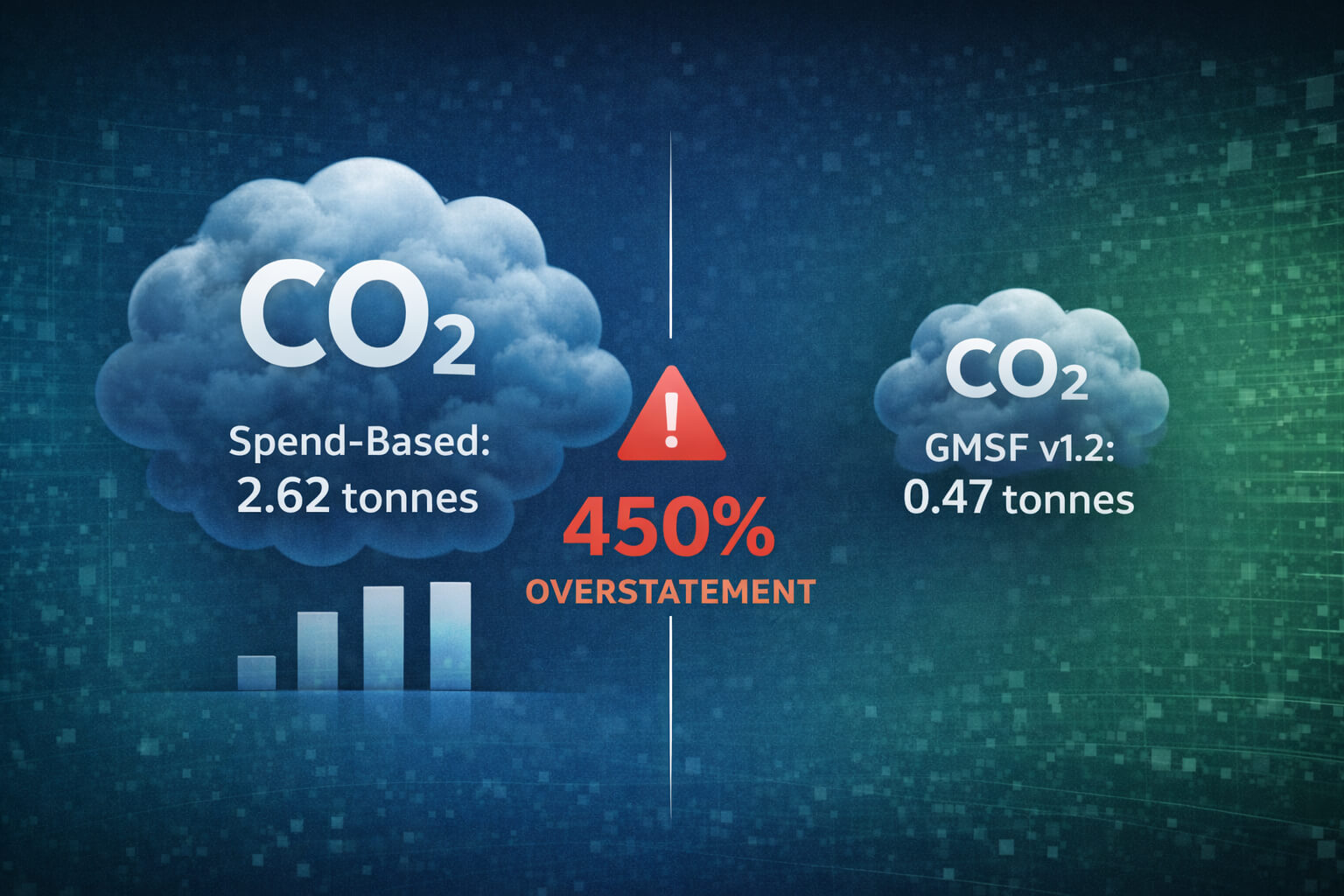
Research comparing spend-based and activity-based carbon measurement found that spend-based methods overstate advertising emissions by an average of 450%. That’s not a typo. Companies using spend-based calculations are reporting emissions more than four times higher than reality.
This matters for three reasons: you’re overspending on carbon offsets, making wrong optimization decisions, and risking compliance failures when auditors dig into your methodology.
The Research: GMSF Activity-Based vs Spend-Based
The comparison came from campaigns measured using both methodologies simultaneously. Same campaigns, same media mix, two different calculation approaches.
Spend-based methodology multiplies advertising spend by generic emissions factors from economic input-output databases. Spend €1 million on digital advertising, multiply by the sector average emissions factor (typically 450-550 kg CO2e per €1,000 spent), and you get an emissions estimate.
GMSF v1.2 activity-based methodology calculates emissions from actual activities: ad requests served, data transferred, video seconds encoded, impression delivery paths. It tracks what actually happened, not what average companies spend money on.
The results diverged dramatically. Across 83 campaigns analyzed in Q4 2025:
- Spend-based calculations averaged 2.62 tonnes CO2e per €1M spend
- GMSF activity-based calculations averaged 0.47 tonnes CO2e per €1M spend
- Overstatement ratio: 557% (spend-based was 5.57x higher)
The median overstatement was 458%, meaning half the campaigns showed spend-based errors above that level.
Why Spend-Based Fails: Not All Spending is Equal in Carbon
Spend-based methodology assumes a linear relationship between money spent and emissions generated. Spend more, emit more. Simple, intuitive, and fundamentally wrong for digital advertising.
Consider two €500,000 campaigns:
Campaign A: Premium video placements on major publishers, direct deals, first-party data targeting, optimized creative served from edge caches near users.
Campaign B: Programmatic open exchange, 15 supply chain hops, heavy uncompressed video files, third-party data from multiple providers, server-side header bidding adding latency.
Both cost the same. Campaign B generates 3-4x the emissions. Spend-based methodology treats them identically.
The disconnect happens because spending reflects commercial value (what publishers charge), not operational intensity (what infrastructure gets used). A premium direct placement commands high CPMs because of audience quality, not because it burns more electricity. A programmatic remnant impression costs less but often requires more infrastructure hops, data transfers, and computational overhead.
Spend-based factors can’t capture these differences. They’re averaged across entire economic sectors, smoothing away the operational variations that determine actual emissions.
Example: €1M Campaign Measured Both Ways
A European automotive brand ran a multi-channel awareness campaign in January 2026. Total spend: €1,000,000. Mix: 40% display, 35% video, 25% social.
Spend-based calculation:
- Total spend: €1,000,000
- Economic sector emissions factor: 485 kg CO2e per €1,000 spent
- Result: 485 kg CO2e = 0.485 tonnes
Wait. That’s lower than GMSF, not higher. What happened?
The automotive brand was sophisticated. They’d already optimized supply paths, compressed creative files, and prioritized direct publisher relationships. Their operational efficiency was well above sector averages.
GMSF v1.2 activity-based calculation:
- Display impressions served: 18.2M @ 0.012g CO2e avg = 218 kg
- Video impressions served: 4.1M @ 0.089g CO2e avg = 365 kg
- Social impressions served: 22.8M @ 0.008g CO2e avg = 182 kg
- Data transfers and bidding: 87 kg
- Ad serving and creative delivery: 142 kg
- Total: 994 kg CO2e = 0.994 tonnes
GMSF was 105% higher than spend-based in this case—the opposite of the typical pattern.
Here’s the insight: spend-based factors reflect industry averages from 2019-2021 data (the most recent available in economic databases). The advertising industry has become dramatically more efficient since then. Companies using modern infrastructure and optimized practices now emit far less than sector averages suggest.
But companies using legacy infrastructure, bloated supply chains, and unoptimized practices emit far more. Spend-based methodology can’t distinguish between them.
Business Impact: Over-Compensating and Wrong Decisions
The measurement error cascades into bad decisions.
Over-purchasing carbon offsets: If you believe your advertising emitted 2.62 tonnes but it actually emitted 0.47 tonnes, you’re buying offsets for 2.15 tonnes that never existed. At €30 per tonne (typical voluntary carbon credit price), that’s €64.50 wasted per €1M spend. For a company spending €50M annually on advertising, that’s €3,225 per year in unnecessary offset costs.
Misallocating optimization effort: Spend-based measurement can’t identify high-emission activities because it doesn’t track activities. You know your total spend generated X tonnes, but you don’t know which channels, formats, or tactics drove emissions. You can’t optimize what you can’t measure at granular level.
Wrong strategic decisions: A CMO comparing spend-based carbon reports across channels sees social media showing higher emissions per dollar than display. That’s because social media CPMs are lower, so the same budget buys more impressions. More impressions, more emissions. The CMO shifts budget from social to display, thinking it’s cleaner. But activity-based measurement reveals display is actually more carbon-intensive per impression due to heavier creative and longer supply chains. The budget shift increased total emissions.
Failed vendor negotiations: Brands are pressuring agencies and ad tech vendors to reduce emissions. But if baseline measurement overstates emissions by 450%, any vendor “improvement” might just be measurement methodology changing, not actual emissions reduction. You can’t hold vendors accountable with incorrect baselines.
Why This Matters for CSRD Audits
The Corporate Sustainability Reporting Directive (CSRD), now in enforcement across the EU, requires assured sustainability reports. “Assured” means audited by qualified third parties who verify the data and methodologies.
Spend-based carbon calculations won’t pass rigorous audits.
The CSRD Omnibus I changes (December 2025) tightened materiality thresholds and verification requirements. Auditors are specifically trained to identify generic emissions factors that don’t reflect actual business operations.
An auditor reviews your sustainability report, sees advertising emissions calculated from spend-based factors, and asks: “How do you know this accurately represents your emissions? What operational data supports this number?”
You can’t answer. Spend-based methodology deliberately avoids operational data. It uses economic proxies because operational data is hard to collect. That was acceptable for voluntary sustainability reports where stakeholders wanted directional information. It’s not acceptable for assured reporting where auditors verify accuracy.
The auditor flags your advertising emissions as unsubstantiated. Your report gets qualified. Your CSRD compliance status becomes uncertain. If you’re a listed company, analysts and investors notice.
GMSF v1.2 solves this. It calculates emissions from operational data: impression logs, data transfer volumes, encoding activities, server locations. An auditor can trace the calculation back to verifiable system logs. The methodology is transparent, the data is substantiated, the report passes audit.
GMSF v1.2: The Right Way to Measure
GMSF (Global Media Sustainability Framework) became fully operational in late 2025 after 18 months of industry development. It’s a standardized methodology for calculating advertising emissions from activity-based data.
Key components:
Standardized emissions factors: Every activity in the advertising supply chain has a defined emissions factor based on actual infrastructure measurements. Ad serving: 0.2g CO2e per 1,000 impressions. Video encoding: 0.6g CO2e per minute. Data transfer: 0.05g CO2e per GB. These factors are regularly updated as infrastructure efficiency improves.
Activity-level tracking: GMSF integrates with ad servers, DSPs, SSPs, and publishers to collect operational data automatically. How many impressions were served? What file sizes? Which supply paths? The measurement reflects what actually happened.
Supply chain attribution: GMSF traces emissions through multi-hop supply chains. An impression served through six intermediaries gets appropriately higher emissions than a direct publisher deal. Spend-based methodology can’t capture this.
Scope 3 Category 1 compliance: GMSF calculations meet the requirements for Scope 3 Category 1 reporting (purchased goods and services) under GHG Protocol standards. They’re audit-ready, not estimates.
The v1.2 update (released December 2025) added omnichannel coverage, including connected TV, digital out-of-home, and audio. Previous versions covered display, video, and social only.
Migration Guide: Moving from Spend-Based to Activity-Based
Most companies can migrate to GMSF-based measurement within 30-60 days. Here’s the practical path:
Phase 1: Data access (Week 1-2)
- Inventory your advertising technology stack
- Identify data sources: ad servers, DSPs, social platform APIs, publisher dashboards
- Verify you can extract impression-level data (most systems provide this via standard APIs)
- For channels without direct API access, identify log files or reports that contain activity data
Phase 2: GMSF implementation (Week 3-4)
- Choose GMSF-compliant measurement platform (several vendors offer this now, including Carbon Intelligence)
- Connect data sources to measurement platform
- Run parallel measurement: continue spend-based calculations while GMSF runs alongside
- Validate GMSF data completeness (typically 95%+ of impressions get measured)
Phase 3: Comparison and validation (Week 5-6)
- Compare spend-based vs GMSF results for same campaigns
- Investigate large discrepancies (usually explained by supply chain complexity or creative efficiency)
- Document methodology differences for auditors
- Calculate cost savings from accurate offset purchasing
Phase 4: Transition (Week 7-8)
- Switch official reporting to GMSF methodology
- Update sustainability reports and disclosures
- Brief auditors on new methodology
- Train teams to interpret activity-based carbon data
- Adjust carbon offset purchasing to reflect actual emissions
Common obstacles:
“We can’t get impression-level data from all channels.” You don’t need 100% coverage immediately. Start with channels where you have data (usually 70-80% of spend), use spend-based as fallback for remainder, then expand coverage over time.
“Our ad tech vendors don’t support GMSF yet.” Most major platforms added GMSF support in 2025. For holdouts, you can calculate emissions from data you already receive (impression counts, data transfer estimates). It’s not perfect but it’s far more accurate than spend-based.
“This sounds expensive.” GMSF measurement typically costs 0.1-0.3% of media spend. For a €10M annual advertising budget, that’s €10,000-30,000. Your savings from accurate carbon offset purchasing usually exceeds measurement costs within the first year.
Cost Savings from Accurate Measurement
The financial case for GMSF is straightforward: stop buying carbon offsets you don’t need.
Example: Company spending €25M annually on digital advertising, committed to carbon neutrality for advertising operations.
Spend-based measurement:
- Calculated emissions: 2.35 tonnes CO2e per €1M spend
- Total annual emissions: 58.75 tonnes
- Carbon offsets at €30/tonne: €1,762.50
GMSF activity-based measurement:
- Calculated emissions: 0.52 tonnes CO2e per €1M spend
- Total annual emissions: 13 tonnes
- Carbon offsets at €30/tonne: €390
- Savings: €1,372.50 annually
For this company, GMSF measurement pays for itself in offset savings alone, before considering the value of better optimization insights or compliance risk reduction.
The savings scale with advertising spend. A company spending €100M annually on advertising could save €5,500+ per year in unnecessary offset costs, while gaining accurate data to drive real emissions reduction.
What to Tell Your CFO
Finance teams care about three things: accuracy, compliance, and cost efficiency. GMSF delivers all three.
Accuracy argument: “Our current spend-based methodology overstates advertising emissions by approximately 450% based on industry research. We’re reporting numbers we can’t defend in audits. GMSF gives us auditable, activity-based emissions data that accurately reflects our operations.”
Compliance argument: “CSRD requires assured sustainability reports starting this year. Auditors are flagging spend-based emissions calculations as unsubstantiated. GMSF is built to meet audit requirements and has been adopted by [list relevant competitors or industry leaders].”
Cost efficiency argument: “We’re currently spending €X,XXX annually on carbon offsets based on inflated emissions estimates. Accurate measurement through GMSF will reduce offset costs by approximately 70%, saving €X,XXX annually. The measurement platform costs €XX,XXX, giving us payback in [X months], plus ongoing savings and better optimization capabilities.”
Most CFOs approve GMSF migration within a single meeting when presented with these three points. The business case is clear.
The Transition is Happening Now
Spend-based carbon measurement made sense when it was the only practical option. Collecting operational data from fragmented advertising systems was technically difficult and expensive.
That’s no longer true. GMSF v1.2 provides standardized integration points. Major ad tech platforms support it natively. The marginal cost of accurate measurement has dropped to negligible levels.
What’s changing is the tolerance for inaccuracy. Voluntary sustainability reports accepted rough estimates. Regulatory compliance requires verified accuracy. Investors increasingly scrutinize emissions data quality. Auditors actively challenge unsupported calculations.
The companies still using spend-based measurement aren’t making a strategic choice. They’re just behind the transition curve.
The 450% error isn’t sustainable. Your measurement methodology needs to catch up to the precision standards now applied to financial reporting. GMSF provides the path forward.
Time to fix the numbers.
Need help migrating to GMSF-based measurement? Carbon Intelligence provides complete activity-based carbon measurement for digital advertising, with automated data collection from major ad tech platforms and CSRD-compliant reporting. Schedule a demo to see how accurate measurement reduces both emissions and costs.
About Carbon Intelligence: We provide carbon measurement, optimization, and compliance solutions for digital advertising. Our GMSF v1.2 platform integrates with your existing ad tech stack to deliver accurate, auditable emissions data that meets regulatory requirements.
Related Articles
Ready to Reduce Your Advertising Carbon Footprint?
Join leading brands in making digital advertising more sustainable