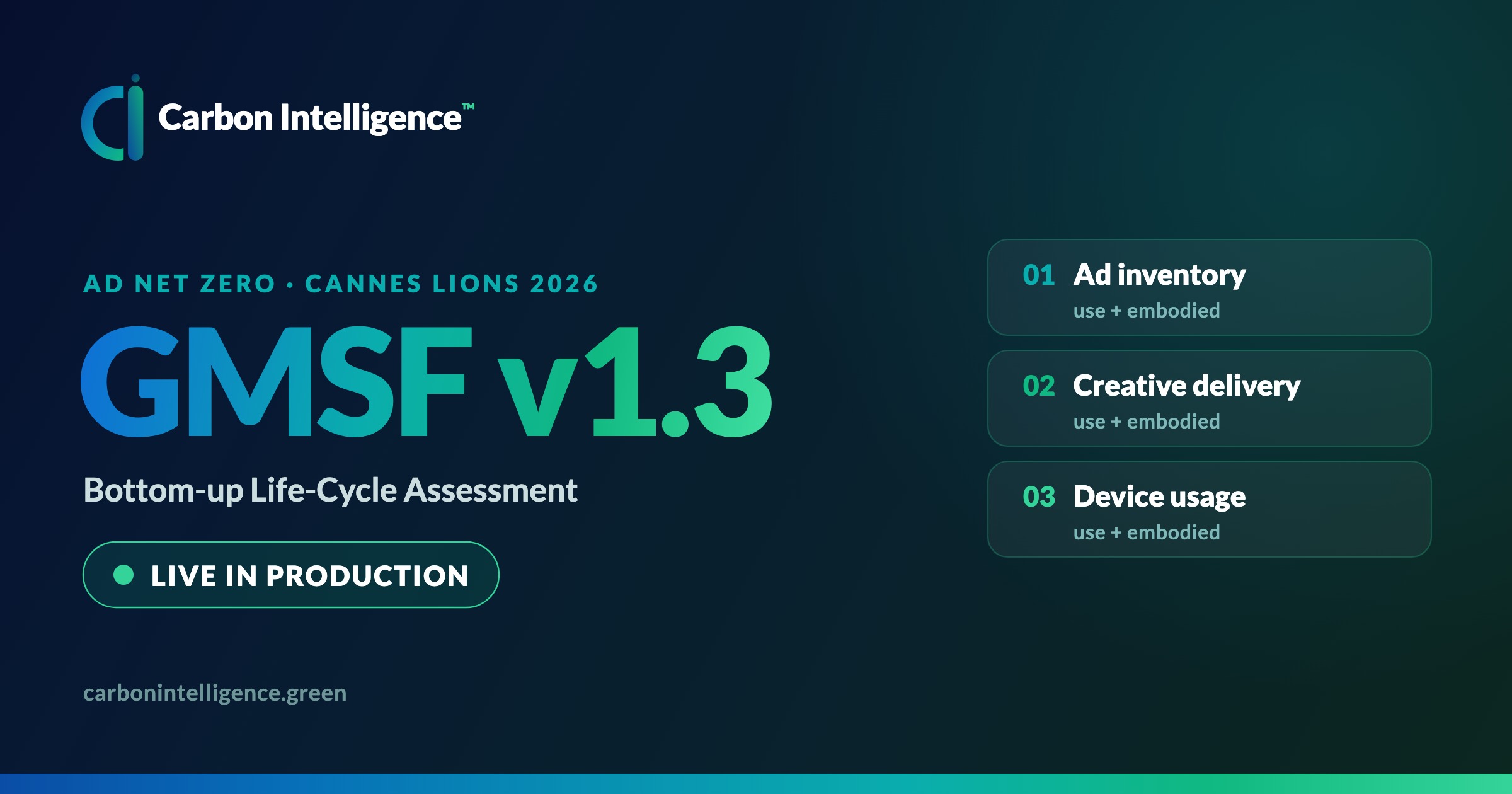
In June, Ad Net Zero published version 1.3 of its Global Media Sustainability Framework (GMSF). According to the organization, it makes it possible to calculate emissions for the channels that account for 95% of global media spend. Beyond digital, it adds implementation guides for TV, out-of-home and print, with those for audio and cinema expected in the second half of 2026.
On paper, then, the industry has a common language, even if the framework remains voluntary. Yet more than three months later, the market seems subdued. What is really going on?
Carbon measurement and GMSF v1.3: a topic that has gone quiet
Attention was elsewhere from the start. Ad Net Zero published v1.3 on 23 June, in the middle of Cannes Lions week, as part of its London-to-Cannes program. The trade press picked it up, but the festival was mostly talking about something else. According to the media monitoring company Onclusive, which analyzed 95,680 mentions, sustainability had a 2.3% share of voice, against 18.2% for AI and innovation.
A survey points the same way, with caveats. In IAB Europe’s State of Readiness 2026 study (fieldwork from November 2025 to January 2026), the risks linked to AI content ingestion are the most-cited challenge among adtech players, agencies and advertisers: 60%. Environmental sustainability comes only fifth (28%), behind the economic environment (52%), measurement (40%) and ad fraud (32%). Read it with caution: it is a ranking of challenges (three choices per respondent), based on 41 respondents in total, and it predates Cannes and v1.3, so it shows where the topic ranks rather than a decline.
An op-ed published in late July on ExchangeWire goes further: it claims that buyers no longer ask for sustainability and that supply has adjusted accordingly. Here is one example, at least: in late September, Scope3, which started out as an ad emissions calculator, became Apostra and is refocusing on media buying by AI agents. According to Adweek, the company’s leadership is open about moving away from sustainability as the core business and judges the topic less promising, notably in the US political climate. The carbon business continues under the name Scope3 by Apostra.
What we see in the field
Our experience is in line with this. From where we sit, only a handful of advertisers, already well advanced on the topic, are still measuring and optimizing. Agencies remain interested, but we are getting fewer requests. For most, carbon is no longer a priority in itself. This isn’t the result of a survey, just our reading of the market.
A study by Abintus Consulting, published in April and surveying 12 agencies from several groups, backs this up on a small scale: about 20% of their clients never ask for sustainable media and, when agencies propose it unprompted, only about 20% respond favorably, while most say it is not a priority. A small sample, so an indication rather than a measurement.
In the IAB Europe study, the share of respondents who estimate the environmental impact of all their campaigns is still a minority (25%, out of 40 respondents), but it doubled between 2025 and 2026. A useful counterpoint, even on a small sample.
For us, that’s where the stakes are. Measurement isn’t an end in itself: it’s there to support optimization. And combining the two is how you can check, campaign by campaign, where lower emissions also work in favor of profitability, and where they call for a trade-off. Profitability, after all, remains an advertiser’s primary objective.
Disinterest or a shift in framing?
A bit of both, in our view: the disinterest is there, but it doesn’t explain everything.
First, a counterpoint. In an IAB UK article published on The Drum on 8 September, in which six experts weigh in, Ryan Cochrane (Good-Loop) observes that over the past six to twelve months, more agencies, trade associations, brands, adtech players and media companies have been getting more deeply involved, despite a difficult macroeconomic backdrop. In Cochrane’s view, the noise has died down, but the work has ramped up. No figures are offered.
This doesn’t line up exactly with what we see, but both can be true: a core group of players investing more is compatible with us getting fewer requests. Less noise doesn’t necessarily mean less activity.
Next, some field feedback we can’t source: in a more tense political climate, some advertisers still care about the topic but hesitate to talk about it publicly.
Finally, among the people we meet, carbon alone is no longer enough to trigger a budget. The argument that still lands is efficiency. Voices in the industry make this case. In the same Drum article, Lucy Zakrzewska (Impact Plus) sees efficiency and sustainability as two effects of the same correction: buying media more deliberately, with a better idea of where it ends up. And in the June press release on v1.3, Sebastian Munden, chair of Ad Net Zero, states that sustainable advertising delivers commercial results through better effectiveness, efficiency gains and less waste. These are stated positions, not measurements.
What is moving forward anyway
On the agency side, measurement can become automatic rather than a choice. Havas Media Network UK offers an example: since January 2026, its clients are signed up by default to its sustainable media offers (an “opt-out” model) and have to withdraw if they do not want them. The agency says that about 40% of its media investment went through its carbon calculator in 2025, with emissions reductions of up to 10%.
Some caveats, though: these figures are self-reported by the agency, with no detailed methodology, and they predate the opt-out. The “up to 10%” is a ceiling, not an average, and the figures say nothing about the cost or the return of the campaigns. They show where the agency is starting from, not what the new model changes.
Other examples point the same way. Havas says it launched a similar opt-out approach in France in 2025, and WPP writes in its 2025 annual report that Wavemaker UK applies carbon reduction strategies by default to all of its clients’ media plans, unless they object. In both cases, the groups are talking about themselves.
Three ideas for advertisers and agencies
- Measure once, on a common basis. The GMSF is a voluntary framework, a recognized methodology among others, but it offers a shared language. The need is real: according to Abintus, more than 80% of the agencies surveyed use a carbon calculator, but all of them are proprietary and no common standard is in use. So we might as well use the GMSF rather than start from zero with every brief. We cover what v1.3 changes in another article.
- Link carbon to inventory quality. Less waste means, in principle, lower emissions and a better return on investment: it is the argument that holds up best in front of an executive committee. In the IAB Europe study, the most-cited optimization actions, such as avoiding MFA (made-for-advertising) inventory or optimizing supply paths, are also the ones closest to business performance (63% and 44% of the 27 respondents concerned). They show what the industry is putting in place, not what it brings in. The GMSF Playbook also sets a guardrail: emissions data should be read in light of business objectives and should not, on its own, change the media strategy.
- Build measurement into the process (brief, RFP, reporting) rather than making it a separate project. Sustainable media RFPs are already starting to do this. For the regulatory reporting angle, see the Omnibus and the CSRD.
In a quieter period, what does carbon measurement change?
This period is quieter. That may be an advantage: without the fad, the question becomes “what does this change for my campaigns?” At Carbon Intelligence, that is the question we help settle. Our platform, aligned with GMSF v1.3, ISO 14064 and the GHG Protocol (our methodology), tracks the footprint over time and compares campaigns, so that carbon becomes one optimization criterion among others.
See what measurement changes for your campaigns
Frequently asked questions
What is GMSF v1.3 and what does it cover?
Is the advertising industry losing interest in carbon measurement?
Can reducing a campaign's carbon footprint also improve profitability?
Sources and references
- Ad Net Zero, press release on the publication of GMSF v1.3 (23 June 2026), adnetzero.com. The 95% figure is attributed there to WARC (2025).
- Ad Net Zero, GMSF Playbook v1.3 (June 2026), PDF
- Onclusive, “Cannes Lions 2026: A deep dive into award winners, agencies, and industry trends” (30 June 2026), onclusive.com
- IAB Europe, State of Readiness: Sustainability in Digital Advertising Report 2026 (4 March 2026), PDF
- ExchangeWire, “The Quiet Retreat of Sustainability in Ad Tech” (29 July 2026), exchangewire.com
- Adweek, “Apostra Wants to Be the Agentic Ad Layer. Does the Industry Need One?” (24 September 2026), adweek.com, and “Scope3’s Rebrand to Apostra Solidifies Shift from Sustainability to AI” (23 September 2026), adweek.com
- The Drum, “What a shared emissions standard changes for media buyers,” an IAB UK article (8 September 2026), thedrum.com
- Abintus Consulting, “Sustainable Media in 2026: What Media Agencies Are Really Doing” (28 April 2026), abintus.consulting
- VideoWeek, “Havas UK is making clients opt out of sustainable media plans” (28 January 2026), videoweek.com
- Havas Group, Impact Report 2025 (April 2026), PDF
- WPP, Annual Report 2025, sustainability section (March 2026), PDF